Industrial IoT: Merging Automation with Data-Centric Industrial Systems in 2026

From Automation to Connected Industrial Intelligence
By 2026, the Industrial Internet of Things (IIoT) has evolved from a conceptual extension of automation into a foundational layer of industrial operations. It is no longer limited to connecting machines; it is redefining how industrial systems generate, process, and act on data in real time.
Traditional automation focused on predefined processes and isolated control systems. IIoT introduces continuous data exchange across machines, production lines, and enterprise systems, enabling dynamic optimization rather than static execution.
This transition is shifting industrial operations from deterministic workflows to adaptive, data-driven environments where performance is continuously refined through feedback loops.
Data as the Operating Core of Industrial Systems
At the center of IIoT is the systematic capture and utilization of industrial data. Sensors embedded across machinery, infrastructure, and supply chains generate high-frequency data streams covering performance, utilization, environmental conditions, and operational efficiency.
This data is not merely observational. It forms the basis for decision-making across the entire industrial lifecycle, from production scheduling to maintenance planning and supply chain coordination.
The ability to structure and interpret this data effectively is now a primary determinant of industrial competitiveness. Operators with integrated data architectures achieve higher efficiency, reduced downtime, and more predictable output.
Predictive Maintenance and Asset Optimization
Predictive maintenance represents one of the most immediate and commercially impactful applications of IIoT. By analyzing equipment performance data in real time, systems can identify early indicators of failure and trigger maintenance interventions before breakdowns occur.
This approach reduces unplanned downtime, extends asset life, and improves capital efficiency. In asset-intensive industries such as manufacturing, energy, and transport, the financial impact is material.
Maintenance is no longer reactive or schedule-based. It is condition-driven, supported by continuous monitoring and machine learning models that refine predictions over time.
Asset optimization extends beyond maintenance. IIoT enables more precise utilization of equipment, ensuring that capacity is aligned with demand and operational constraints.
Real-Time Monitoring and Operational Control
IIoT provides continuous visibility across production environments. Real-time monitoring systems track performance metrics, identify deviations, and enable immediate corrective action.
This level of control reduces inefficiencies and improves output consistency. Production managers can respond to issues as they arise, rather than relying on post-process analysis.
The integration of monitoring systems with control platforms allows for semi-autonomous adjustment of production parameters. Over time, this evolves toward fully autonomous systems where optimization decisions are executed without direct human intervention.
The result is a shift toward self-regulating industrial environments with higher levels of precision and reliability.
Supply Chain Integration and Network Visibility
IIoT extends beyond factory floors into broader supply chain networks. Connected systems provide visibility across inventory, logistics, and distribution, enabling more coordinated and responsive supply chain management.
Real-time data on inventory levels, transit conditions, and demand patterns allows for more accurate forecasting and improved allocation of resources. This reduces excess inventory, minimizes delays, and enhances overall supply chain resilience.
Integration across supply chain nodes is increasingly important. Manufacturers, logistics providers, and distributors are linking systems to create unified data environments, enabling end-to-end optimization.
This connectivity is particularly valuable in managing disruptions, where rapid visibility and response capability can mitigate operational impact.
Smart Factories and Autonomous Production Environments
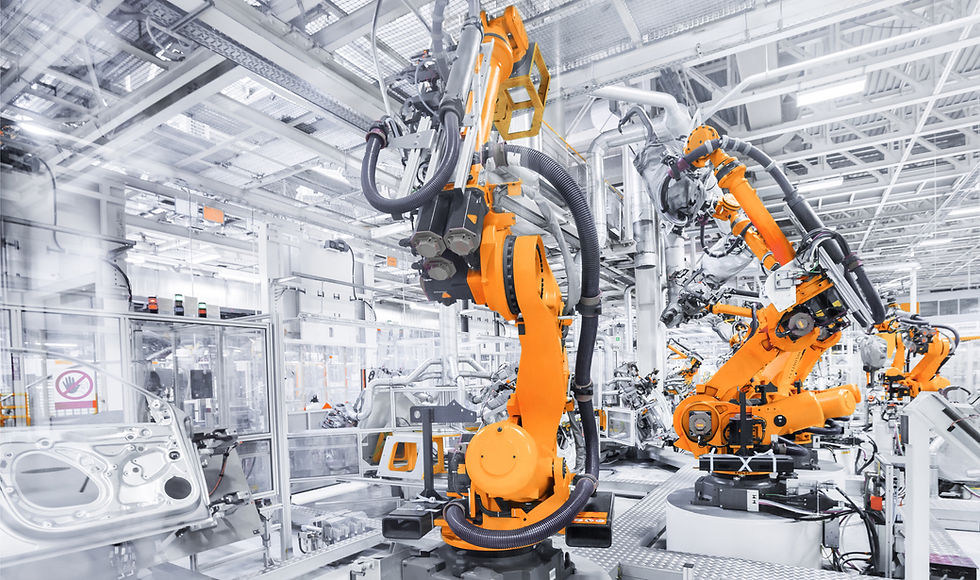
The concept of the smart factory is being realized through the integration of IIoT, artificial intelligence, and advanced robotics. These environments operate with a high degree of autonomy, where machines communicate, coordinate, and optimize processes in real time.
Production lines are becoming modular and flexible, capable of adapting to changes in demand or product configuration without significant downtime. This supports more responsive manufacturing models and reduces the cost of product variation.
Human involvement shifts toward oversight, system management, and exception handling. Routine operational tasks are increasingly executed by interconnected systems.
Smart factories represent the convergence of physical and digital infrastructure, creating industrial environments that are both highly efficient and continuously adaptive.
Investment Landscape and Strategic Opportunities
IIoT is creating a multi-layered investment landscape, spanning hardware, software, and integrated platforms.
IIoT platforms are a primary area of focus. These systems connect devices, aggregate data, and provide analytical capabilities that enable operational optimization. Scalable platforms with cross-industry applicability are particularly attractive.
Sensor technology remains a critical component. Advances in precision, durability, and cost efficiency are expanding the range of measurable parameters, increasing the depth and quality of industrial data.
AI-driven analytics tools are central to value creation. The ability to process large datasets and generate actionable insights differentiates leading platforms from basic connectivity solutions.
Edge computing is emerging as a key enabler. Processing data closer to the source reduces latency and supports real-time decision-making, particularly in environments where immediate response is required.
Integrated solutions that combine connectivity, analytics, and operational control are positioned to capture the most value, particularly where they can be deployed across complex industrial networks.
Integration Constraints and Legacy Systems
One of the primary challenges in IIoT deployment is integration with existing infrastructure. Many industrial environments operate on legacy systems that were not designed for connectivity or real-time data exchange.
Retrofitting these systems requires both technical adaptation and capital investment. Compatibility issues, data standardization, and system interoperability must be addressed to enable effective integration.
Operational disruption during implementation is a further consideration. Transitioning to IIoT-enabled systems must be carefully managed to maintain production continuity.
Companies that successfully navigate integration challenges gain a structural advantage, as they can leverage both existing assets and new capabilities within a unified system.
Cybersecurity and Data Integrity
The expansion of connected systems introduces increased exposure to cybersecurity risk. Industrial networks are now potential entry points for cyber threats, with implications for both operational continuity and data integrity.
Robust security frameworks are essential. This includes encryption, network segmentation, access control, and continuous monitoring of system activity.
Data integrity is equally critical. Inaccurate or compromised data can lead to flawed decision-making and operational disruption. Ensuring data reliability requires disciplined governance and validation processes.
Cybersecurity is no longer a peripheral concern. It is an integral component of IIoT system design and operation.
Workforce Transformation and Capability Development
The adoption of IIoT is reshaping workforce requirements. Traditional operational roles are being supplemented or replaced by positions focused on data analysis, system integration, and digital infrastructure management.
This creates a skills gap that must be addressed through training and development. Engineers, operators, and managers require new competencies to effectively engage with connected systems.
Organizations that invest in workforce capability are better positioned to extract value from IIoT deployment. Without this alignment, technological investment may not translate into operational improvement.
Forward Outlook: Integrated, Self-Optimizing Industrial Networks
IIoT is driving the evolution of industrial systems toward integrated, self-optimizing networks. The combination of connectivity, data analytics, and automation is creating environments where performance is continuously monitored and refined.
The long-term trajectory is toward fully autonomous industrial ecosystems, where decision-making is distributed across interconnected systems and executed in real time.
For investors and operators, the opportunity lies in identifying platforms and technologies that enable this integration. Value will be concentrated in systems that can connect, interpret, and act on data across complex industrial environments.
IIoT is not a discrete technology layer. It is a transformation of how industry operates, shifting from isolated processes to interconnected systems defined by data, intelligence, and continuous optimization.
Connect with XCAP Alliance
XCAP Alliance is a global investment banking firm operating across private capital markets, with senior practitioners positioned across key financial centers in North America, South America, Europe, the Middle East, Israel, Asia, and Australia.
The firm advises on mergers and acquisitions, capital raising, and complex cross-border transactions, delivering mandates that require disciplined structuring, institutional-grade execution, and coordinated access to global capital. Engagement is defined by precision, confidentiality, and alignment between capital providers, corporate clients, and transaction counterparties.
XCAP Alliance operates through an integrated global platform combining origination capability, execution expertise, and established relationships with private equity sponsors, sovereign institutions, family offices, credit funds, and strategic acquirers. Opportunities are assessed and advanced within a structured framework designed to ensure relevance, quality, and alignment with investor mandates and capital deployment strategies.
The firm engages selectively on transactions requiring coordination across jurisdictions, sectors, and capital sources. All engagement is undertaken on a confidential basis.
Further information is available at www.xcapalliance.com


Comments